


When you purchase through links on our site, we may earn an affiliate commission. Here's how it works. |
In a recent published interview with French publication Phototrend.fr, a pretty big bit of information came from Canon themselves. It doesn't sound like the lack of third-party autofocus lenses for the RF mount has anything to do with Canon.
Full Frame Sigma RF Lenses
While I touched on it in the interview, I think the comment made by Canon executive Go Tokura is worth its own small article for the search engines. Canon says that it's up to Sigma to make full-frame lenses.
As we know, Canon has been dragged through the mud for years because there are no third-party autofocus full-frame lenses available for the RF mount. Though a few did slip through. Soon after the EOS R system was announced in 2018, Samyang did release a few autofocus full-frame lenses. They were simply EF lenses with a mount swap for the most part. Canon quickly asked Samyang to stop selling the lenses, and that was that.
We have seen Nikon go after Vitrox and others for producing full frame Z mount lenses without permission, but the Z mount does have a few more third-party full-frame options than the RF mount.
Opening the Mount
The quote in question from Go Tokura says that Canon doesn't differentiate between APS-C and full-frame lenses when it comes to their approval process for third-party manufactuers.
We don't really differentiate between full-frame and APS-C in this regard, and we don't communicate publicly on this subject. I think this observation comes from an outside perspective, based on the fact that third-party lens manufacturers are currently only involved with APS-C.
Go Tokura https://phototrend.fr/2026/03/interview-canon-cpplus-2026/
Why on earth did it take Canon so long to say this? If they did in the past, I think pretty much everyone missed the memo. I doubt they were doing Sigma a favour, and it certaintly hasn't helped Canon's own marketing. Shooters have been yelling from the rooftops that they're switching brands because they can't get some of the cool Sigma lenses.
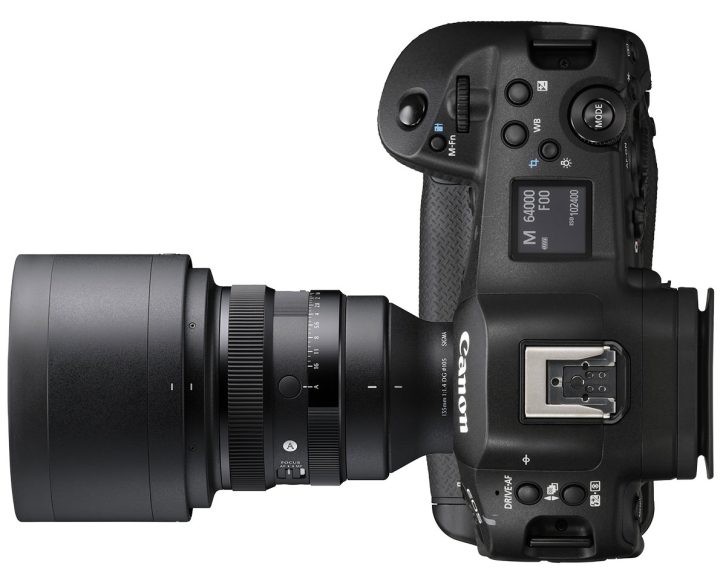
Why hasn't Sigma made any full frame RF lenses?
That's a good question and I can only hypothesize. Obviously no one at Canon or Sigma is going to answer an email from Canon Rumors.
The RF Mount is Complex
The RF mount is a pretty special mount in the camera world. When Canon launched the EOS R system in 2018, they did say at the time the mount had a lot of technical potential and that they were going to be able to do things they never could with the EF mount, and be able to do things none of the other mounts out there at the time could do.
Sigma has released RF-S versions of their crop sensor prime lenses. They're all very good and perform quite well. They fill a void in Canon's own line up of APS-C lenses.
There could be things the RF mount is capable of that we haven't seen yet. The latest innovation being the auto-iris.
If you're going to release lenses for the RF mount for full frame shooters, I imagine Sigma wants to utilize all the technology that is available.
Which leads to….
Canon executives made it clear that they do not collaborate with third-party lens makers in any way. They have no idea what Sigma or Tamron will be releasing down the road. There are no restrictions on what lenses are “allowed” to be made. Sigma is free to overlap the entire RF line up.
Canon doesn't help out in any way. By the sounds of it, there is no IP being given to Sigma or Tamron to make their lenses work. Like the EF mount, it sounds like all of Canon's tech has to be reverse engineered.
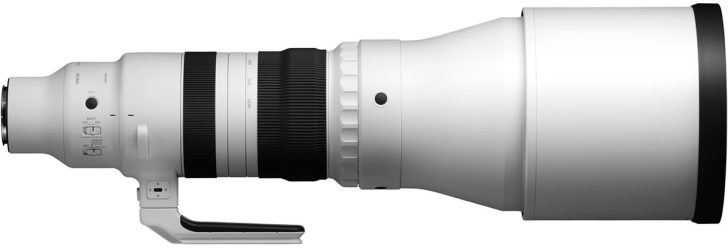
Sigma is a small company
I sometimes wonder if people think Sigma's capabilities in R&D and manufacturing are close to the big camera makers. Canon is obviously an enormous company and easily spends more 4-5 times more on R&D across their business than Sigma's entire yearly revenue.
So if you're Sigma, why would you simply stick an RF mount on your existing line up of lenses and not utilize what's available in the RF mount?
Secondly, does Sigma have the manufacturing capacity to meet the potential demand that would come from the RF mount. Canon sells way more cameras and lenses than anyone else does.
The “Approval” to make lenses
There are assumptions about what Canon's approval process is. The general thought is that it's licensing fees that have to be negotiated. I don't think it is.
I think it has more to do with Canon protecting their IP and making sure that whatever a company like Sigma figures out, it can't go outside of their four walls. Maybe no one outside of Sigma's four walls can help with any of the engineering, or reverse engineering.
Licensing fees wouldn't move the needle for Canon financially at all.
In Closing
I am just guessing as I mentioned. If some of you have other ideas, please sound off on the forum.
I'm sure a few people will think it, but there is no way a Canon executive is going to come out and lie about such a thing.
I wanted to fanboy a bit, because I have even received terse emails about this topic. Sometimes things aren't what they seem and for whatever reason, neither Canon, Sigma or Tamron wanted to talk about it. In some ways, you can understand why.
Canon doesn't care what the third-parties do as long as they ask nicely to use the mount. Canon wants you to buy Canon lenses, they're not going to give you good news about other brands.
Sigma doesn't want to address it because there are a lot of challenges they may not have found solutions for. Which is also understandable; I imagine such an endeavor is difficult.
I'm not saying we owe Canon an apology as a community for the internet hate thrown their way, but it isn't up to them.
It's time to start knocking on some other doors. If you do, do it nicely.



None of the Sigma RF lenses offer autofocusing for the entire viewfinder however; anyone know if the other mount also suffer from this limitation?
Thanks. I left out the word dedicated. I didn't touch on the rest of it because none of that is hard. I think it all has more to do with Sigma not being able to manufacture to the scale required. People grossly overestimate how many lenses SIgma sells.
We now know that it has nothing to do with Canon. There will still be the naysayers, but it doesn't matter what you tell some people.. the vacuum can be strong.
Still, if just capacity then at worst case just add a control ring and the basic EF instruction set and call it a day for gen 1 so that the issue is more a lens mount swap like prior; go fancy for gen 2. People try too hard sometimes with all at once offerings.
M-mountlenses but hadn't received the conversion kits from Japan. As I recall, I got the new lenses on the days that the RF mount version became available in the U.S.Does anybody doubt that Sigma would be overjoyed if the demand for existing FF lenses (plus a few parts) suddenly increased by, wild guess, 30%? They already know how to make lenses for the RF mount. They do it every day.
"Ported" and being able to actually make enough are different things. A lens like the 135 f/1.4 would be a very difficult lens to make within tight tolerances. Sigma made nothing worth owning for most of the EF days. When they did start making things that were sort of nice there were already 100+ million EF lenses. Having worked directly with Gentec, I know how few lenses they sold in the grand scheme in at least one market (maybe 2). It was peanuts.
Demand increasing 30% is great, now you have to scale everything else 30%. There's a point in lots of businesses where the next step costs exponentially more than the previous one.
Take a company like Leica (yes, they do it different). They make 40 cameras a day. Major products usually take about a year to meet the demand. How much would it cost them to increase production to 60 a day? A boatload. Sigma is closer to Leica than they are to Canon. Leica's revenue is actually higher than Sigma's.
Then there's the business relationship issue. Most OEM camera companies use Tamron and Sigma to provide elements of lenses, or even whole lenses. Those OEM relationships are quite important to the companies, and it's not surprising that the little firms like Viltrox were the ones making RF lense while the ones with OEM contracts aren't.
Sigma's CEO has spoken around the issue in several interviews, most notably the recent one where the Petapixel crew visited him in Japan. My impression was that he wasn't able to speak because of an active provision that prevented him from speaking. He's a stand-up guy, and I'd put more faith in what he says (or indicates he can't say) versus a whole sack of OEM company executives.
An impression is a lot different than what he actually said. He has never directly addressed anything on the topic. Sure he's a nice guy, why does he get more credit for not saying anything? Insinuating that an executive at Canon would lie when he could have just said the usual "we don't comment" that they're quite good at.
Canon says, there's no differentiation between APS-C/FF lenses, they don't collaborate at all on products and they have no idea what Sigma's roadmap would be. They said three direct things on the topic, but Mr Sigma is a nice guy.... so....
Someone at Canon Europe says something, it's probably more a guess than actual knowledge. Canon Inc. isn't opening up about their business to subsidiaries. They buy gear from Canon Inc, and then they go sell it. That's it.
OEM relationships wouldn't play a role at all, unless there was transparent exclusivity, which there obviously isn't. Tamron does stuff for Nikon, Tamron also does a bunch of other things. Nikon is closer to exclusivity with an eyewear company than anyone in imaging. Cosina/Voigtlander make elements (and entire lenses) for a pile of companies, they don't seem to be restricted from doing whatever they want. They compete directly against a brand they make lenses for, in the exact same space. No business would sign on to restrict themselves.
Look at the L-Mount alliance, none of those companies are restricted from doing whatever the heck they want. They are pooling some resources like is done in tons of industries, and then directly competing with each other.
What you are referring to are issues with peripheral image correction on third-party EF lenses, those were caused by the camera incorrectly identifying the lens. Such lenses spoof Canon lens ID numbers, and the RF mount made that problematic.
Since those were EF lenses, they required the mount adapter, and thus the distance from the lens to the sensor was the same as that on a DSLR. Optics was not the problem, electronics/software was the issue.
I think most of the folks complaining have been assuming that a licensing deal includes access to the technology and the comments you refer to clearly refute that. That said, figuring out the protocol may be much harder that some think, since the communications could well be encrypted. That pin that switches back to EF protocol may be more complex than many think. It is notable that the folks who got shut down (Samyang, et al) were simply using EF protocol with an RF mount and Canon would have been perfectly justified in zapping them for misrepresentation.
200-400 f4 no built in converter
2nd place a 100-500 5.6 constant aperture.
3rd place their 300-600 f4, a bit overkill for NHL but would be good for football and soccer!
Why should Sigma (or any other 3rd party lens manufacturer) be 'required' to make enough RF lenses to fulfill a very high demand in short time?
Sigma would simply sell as many lenses as they can make, be very happy with the revenue, and later they can decide to increase production capacity if the demand justifies it.
In a free market, any supplier can offer as many product units as he wants, while there is no obligation to produce a very large quantity, even if an initial short supply might disappoint some prospective buyers. After a while production capacities will adjust to the demand.
Additionally, all RF and RF-S cameras use the same RF mount, only the image circle of an RF-S (APS-C) lens is smaller than FF.
Consequently, there is no additional 'technical difficulty' to overcome or any 'reverse engineering' needed for FF RF compared to APS-C RF-S. Note that there are already several 3rd party autofocus RF-S lenses available, e.g. Sigma 15mm f/1.4 DC, so 3rd party manufacturers have already solved the 'technical difficulty'.
1) Sigma already has spent the R&D money to develop full-frame lenses like 300-600/4
2) Sigma already has spent the R&D money to figure out the RF mount, as evidenced with their RF-S lenses.
So why aren't they putting 1 and 2 together? I don't see this being a Sigma issue. It seems logical the issue lies elsewhere.